
Proust to Power - UPDATE
At the half-year mark, I've unexpectedly read three volumes out of six. Oops.

Hello! It’s been a minute since my last post in May. I have a number of things I’ve been wanting to post here about—for example, a number of recent articles about why men don’t read and my own experiences with a local “boys only” book club that I started. So look for that soon!
But at the start of 2025, I posted here about my intention to read the epic novel In Search of Lost Time by Marcel Proust over the course of the next four years. I’ve been meaning to post some kind of update on that goal for ages now, and here it (belatedly) is…
A quick recap: after the election last November, I was trying to wrap my head around the forthcoming years of kakistocracy, corruption, and just utterly disgusting behavior that was sure to continue to flood the news.
A few months into Trump 2.0 now, I think it’s safe to say that in my wildest nightmares back then, I was still severely underestimating the soul-killing daily misery of a second Trump term. Knowing that my country, even friends of mine, voted for that man after every single awful thing they knew to be true about him, has just been a source of perpetual heartache ever since November.
In any case, I came up with a plan last winter to try and weather the coming shitstorm by intentionally engaging with something life-affirming—something that had stood the tests of time—something so massive in scale and historical importance that it would remind me that these dark days would eventually pass.
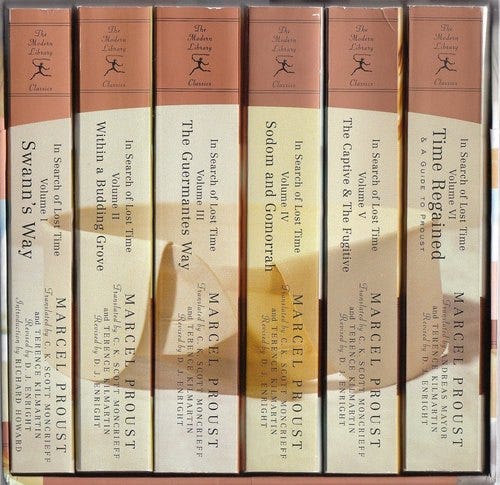
Marcel Proust’s In Search of Lost Time is, for the unfamiliar, a 3800 page novel split into six volumes (depending on the translation) all written and published serially between 1913 and 1927. He started working on it around 1909, and almost half of the volumes were published after Proust’s death in 1922. It is still one of the most highly-regarded and important works of literature of all time.
In any case, my plan was to spread these books out over the course of the coming four years, to read just a few pages a day, so that I could have some kind of throughline to follow—something that would see me safely and sanely to the other side of this very bleak tunnel.
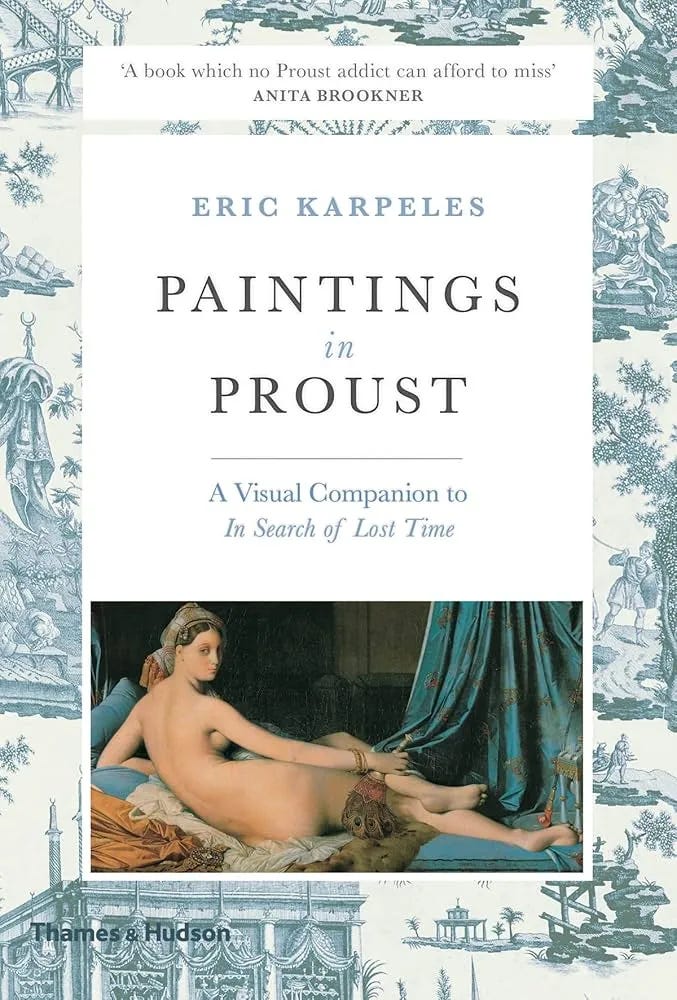
At the start I assumed that, if I failed, it would simply be because I lost interest in the very long book, which I’d been warned involves hundreds of pages dedicated to the ins-and-outs of high society gatherings and other stuff I was worried I’d find deathly boring. I’d figured I’d spend most of this year on the first volume and try to start in on the second. I had some secondary texts to read as well, some guides and some bonus content about the paintings referenced in the novels. I figured I’d be in for the long haul.
But, well—something else happened. It turned out I could not stop reading this novel.
Or, rather, I could not slow down enough to make it last anywhere close to four years.
I finished the first volume, Swann’s Way before the end of January and could not wait even a few months to dig back in again on the second, Within a Budding Grove. I burned through that 600+ page book before the end of the Spring semester.
It is now the end of July and I’ve had to force myself to take a break after just finishing the third book in the cycle, The Guermantes Way.
That’s right—as it stand I’m now about halfway through the whole megillah.
I want to pause here just to say that, just a few years ago, I was struggling to read even a dozen (regular sized) books in a year. My attention span was shot, and I wasn’t making the time to engage with anything longer than a tweet.
But after just two years of trying to consciously read 26 books a year (at least one by an author, going from A-Z) I have become such an avid reader again that I’m currently on my 25th novel of the year, with five months to go. (And three of those are Proust volumes!)
Even when I was younger, and even before social media existed, I never read like this, and it has been tremendous. Not quite enough to keep me from despairing over current events, or to distract me from wasting (some) time online… but it’s a marked improvement, which I feel the benefits of daily.
Anyway, I badly underestimated Proust, and maybe myself a little too—I seriously love this novel and I have not stopped thinking about it all year.
If I’ve stalled a bit in posting an update, it’s partly because I wasn’t sure how to report about the experience in a way that wouldn’t sound silly or reductive or pretentious… although maybe when you’re talking about a 3800 page novel, the pretentious thing is just a given.
But! Maybe I’ll start there. Which is that the book actually doesn’t feel pretentious in the way I expected. Yes, a good deal of the story is about the narrator (who is called Marcel a few times, and is commonly read as a kind of auto-fictional Marcel Proust) and his encounters with high society, particularly the third volume The Guermantes Way, which I’ve just finished.
I’d braced myself for something a bit like watching The Gilded Age or Downton Abbey without the “downstairs” parts of either, just a ton of descriptions of dinner parties and Parisian society gossip and the politics of the rich and so on…
And, well, there is a lot of that, but Proust manages to make all of that about something else that’s much more interesting. So far the novel is really about his steady awakening to the essential shallowness of two different sides of the modern world, and I’m expecting the next few volumes to focus on whatever comes after that awakening.
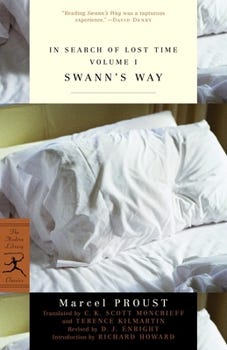
In the beginning you get the stuff you’ve maybe heard about… the madeliene cookie, the narrator trying to get to sleep and thinking back on the past… but this all really is just the opening. Very soon after, we get the narrator describing his boyhood in a French country home in Combray (an imaginary town, in Normandy) and his fascinations with two groups of his upper class neighbors.
Actually he’s in the upper class, so really what he admires are the upper upper class—everyone he wants to hang out with is a Count or a Baron or even several actual Princesses. As a boy he looks up to these people, and wants to learn how to join their ranks when he’s older. He believes that there are universal truths and beauty contained within art, which he hears the adults around him talking about constantly: they attend plays, own paintings, listen to sonatas, and on and on. And then there are the aristocrats, the Counts and Barons and Princesses, who maintain a kind of power through their money and their lineages—the young narrator believes in this order completely and dreams of being a part of that noble class.
These groups are represented symbolically in the book by two different paths (ways) along which he walks as a child through the landscape around Combray.
There is “Swann’s Way” which goes by the estate of M. Swann, a prominent figure who is part of the Verdurin salon of well-to-do artistic types where they listen to performances of the Vinteuil sonata (which makes Mme Verdurin cry) and talk about paintings and plays and such all the time. And there is “the Guermantes Way” which goes by the estate that belongs to the aristocratic members of that royal circle, who are involved in French matters of state and politics.
At first the young narrator leans towards Swann’s way—he wants to be a writer, and he loves the work of a writer named Bergotte, and fantasizes about going to see a theatrical performance by a famed singer that he dreams will be utter perfection. And he idolizes M. Swann, who he understands has bucked societal conventions by marrying a “coquette” named Odette who no one else approves of. But in due time the narrator discovers that people in the Verdurin salon think Bergotte is sub-par. He finally goes to see the theatrical performance and discovers it doesn’t live up to his imagination at all. And when he finds out more about Swann’s situation with Odette, he realizes it is actually pretty much a miserable disaster—one which he is soon to repeat almost exactly with Swann and Odette’s daughter, Gilberte, in the first part of Book Two, Within a Budding Grove.

After the relationship with Gilberte ends, he goes away for the summer to Balbec and he enjoys the new landscape of the seaside, and befriends a boy named Robert Saint Loup, who is from one of these very elite families and has connections to that world. The narrator has somewhat gotten over his idealizing of Swann, now that he understands how he’s disliked by all the other fancy folks he wants to join in with—Swann’s even been disinvited by the Verdurins, because of Odette.
At the beach, the narrator and Saint Loup begin to take notice of a group of girls and eventually concoct a plan to meet them. He falls for one, a girl named Albertine, who invites him up to her room alone, but then is suddenly upset when he attempts to kiss her. Meanwhile he somewhat replaces Swann as a role model with a painter he meets there, named Elstir, who it turns out also has some ties back to Odette (he’s painted her anyway).
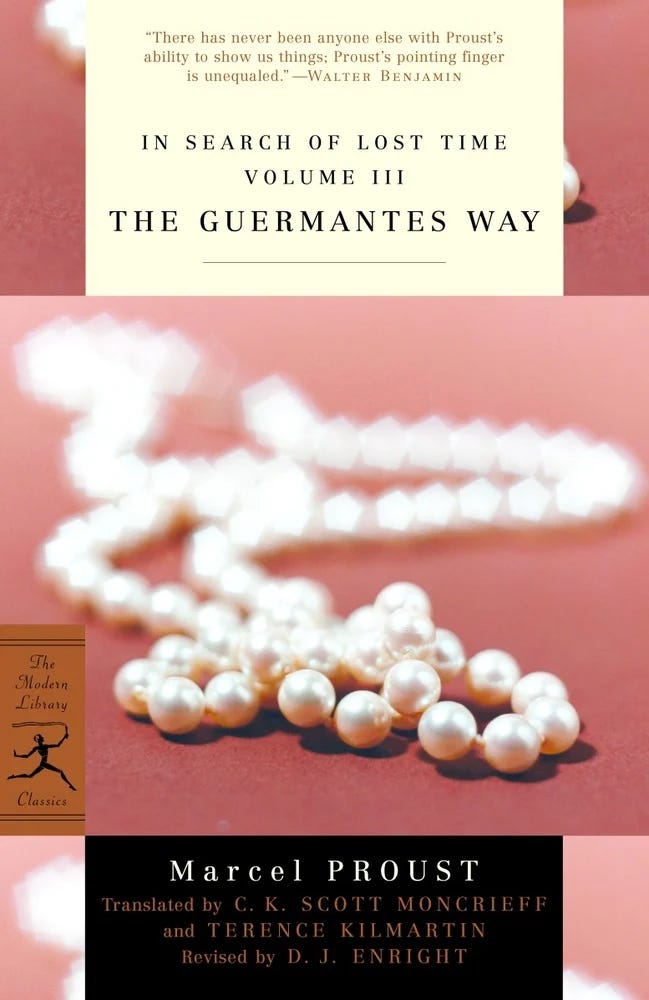
In the third volume, he returns back to Paris and begins to infiltrate high society. His plan is to meet the Princess de Guermantes, through Saint Loup, and under the auspices of wanting to come see some paintings of Elstir’s that she owns. This all takes some time, but eventually pays off. But just as the theatrical performance, or the writings of Bergotte, turn out to be less perfect than he once imagined, so do the upper crust.
There are indeed hundreds of pages of society dinners and details about parties and everything I dreaded, but it all comes in the context of him steadily realizing all of them are, well, full of crap.
They’re rich and they’re important, but he begins to realize that they’re also deeply unintelligent, incredibly petty, and ultimately have no real convictions at all. Their superior titles and lands and lineages don’t actually correspond to their being superior people. Or, rather, they are all superior, but decidedly lacking in any real excellence.
Everyone he meets in the third book is obsessed with talking about the Dreyfus affair—which I had to strain back to my high school Modern European History class to remember the details of. Proust certainly doesn’t give much background, which I realized at some point is because none of these people really cares about it, or understands much about it either.
Everyone is either a stated Dreyfusard or an anti-Dreyfusard, which sometimes does and sometimes doesn’t overlap with them being antisemitic. (There are several Jewish figures who are rabid anti-Dreyfusards, mostly because they’re worried that supporting him will remind the others that they’re Jewish and they’ll be shunned from all the cool parties). Notably Swann, and Proust in real life, are considered to be Jewish—actually they’re all Catholics, but they’re of Jewish descent which is enough to make everyone suspicious.
There are some very moving parts of the book, in between all the gossiping. The narrator’s beloved grandmother has a stroke, and later dies, and these serious moments only deepen the ridiculousness of the social plots around them—in many ways her death begins to feel like a symbolic death of the whole old social order of France. The world she lived in has, at least, almost completely died off—and by the end of the third volume, it seems like the narrator knows it. (The final sequence involves him rushing through a party at the Princess’s mansion, so he can pay a visit to a prominent man named Baron de Charlus afterwards. The Baron proceeds to rabidly chew him out over some perceived (or imaginary?) slight, swear he’ll never talk to the narrator again, and then almost immediately get distracted (or senile?) and seemingly forgetting about the whole thing.)
Where I’m at now, midway through the six volumes of the novel, it seems as if the narrator has begun to really accept the superficialities and flaws of both “ways” that he considered viable in his youth. Will he forge some other path ahead through these next volumes? My sense is that if he does, it will be a kind of artistic path (a genuine one, not the one the Verdurins pretend to support for social capital) that ultimately leads to his writing the novel we’re reading. I’m especially curious how Proust will navigate this, as I’m always fascinated by those who break the “rules” and write about writers writing.
I have to say that I thought the books would feel dated and strange, and that I’d be lost without a ton of historical knowledge of the world of French art and politics in the early 1900s. But every part of it so far has been quite easy to connect to today. The Verdurins and their snooty salons represent a kind of world I have similarly grown pretty bored of—the gathering of smart people who claim to love art and artists but seem to actually just enjoy gossiping about art and artists, with a lot of energy spent on being “correct” about whoever is in and out of vogue at any given moment.
Proust’s book felt like a wonderful reminder, then, of how eternal those types are—those who don’t, themselves, really make art, but who want to feel as if they are a part of the process. These are the folks who are very happy to say they love your work so long as everyone else is also saying it, and then a few months later will act as if they’ve never heard of you at all. (I’m not subtweeting anyone in particular here, I promise… it’s just a world that, I can assure you, very much still exists.)
At the same time, all the Guermantes stuff feels equally familiar. Swap “Dreyfus” out and swap in whatever the topic-of-the-moment happens to be today—AI, crypto, Love Island—and you get the idea. Even deadly serious stuff like Gaza, or Ukraine, or mass deportations to CECOT, in the hands of these kinds of characters, become games played for popularity points.
In Proust’s descriptions, these aristocratic figures never actually evince any genuine care for Dreyfus—the actual imprisoned human being at the heart of the case. They just know it’s something that everyone important must have a strong opinion about, and so they have one. (To be clear I think there are lots of people with actual, serious convictions out there, and I’m sure there were back then too.) But Proust captures the way in which it all becomes swept up in more society gamesmanship. It’s about who gets invited to the next party, and who gets gossiped about, and who is or isn’t “in” at this particular moment. Basically it’s the eternal high school lunch table, and those many people we all know who continue to care about their own popularity above all else.
And I have to say that—at the same time, the novel never feels pointed or cruel, or satirical. Even as Proust’s narrator begins to see through them, all we really feel is his own internal disappointment. It isn’t about him scoring points off of mocking them—which is really refreshing.
There is only one minor critique on my mind at this point—and if you’ve read ahead of me, don’t spoil things in the comments!
So far, I’m finding a lot of the love stories unconvincing—excepting the famous “Swann in Love” section (which weirdly leaves the 1st person POV and jumps to a 3rd person POV close to Swann—is that going to happen again at any point? I’m very much wondering…). But when it is about the narrator and Gilberte or, later, Albertine, or the Princess de Guermantes… I just never quite feel like he’s convincing me that he’s actually in love with them. This may be because he really isn’t — that like his idealizing of art and aristocratic society, maybe love is similarly a false “way”? It may also be that he’s still fairly young. But if anything I’d expect his youthful crushes to feel even more romanticized than they would be if he was older?
It’s hard to ignore that, well, I’m reading this book in the year 2025, fully aware that Marcel Proust was gay—which of course he could not be open about at the time he was alive (though it seems from what I’ve read that it was known in the literary world of Paris back then). I’m told that some of this gets, at least, obliquely addressed in the next volume (which is, scarily, titled Sodom and Gomorrah) so perhaps this is coming into focus soon.
In either case, what does absolutely feel convincing to me are his intense friendships with the other boys in the novel—he seems fully smitten with Saint Loup right now, and earlier with the older Swann, and with Elstir. It strikes me that Proust is quite able to convince me that his narrator adores the heck out of these figures, while with the ladies it is always a bit underwhelming. I’m not sure how much to dwell on this at all, but right now if there’s anything I could think of to criticize the book about, it would be that.
In any case, I’m quite curious to continue with the reading—and at the halfway point now I can see a world in which I finish it all this year, or maybe shortly into next year—a far cry from my original plan to stretch it out. But honestly, this is even better.
One final note, which is that, as I said in my original Proust post, when I was in college I decided not to sign up for a class where I would have had to read all of In Search of Lost Time in one semester, and I’ve always regretted it. One of the things I let persuade me against it, back then, was some advice from another writer I knew, who had done the class and had felt, afterwards, like it had completely overtaken his own style—that being immersed in all these long, looping sentences for thousands of pages had corrupted his own writing somehow. I mean… first of all, imagine being worried that you might end up accidentally writing like more one of the best writers of all time? But somehow this made sense to me then (I had recently just pulled myself out of a Hemingway/minimalist phase) and so I allowed that to be my reason to not take the class.
Anyway, I’m on the lookout now to see if there’s an impact on my own style again—chapters beginning to run to a hundred pages or sentences going for paragraphs on end… but so far I think I’m doing OK. Like I said, a writer could have many worse problems.
So—that’s the update! I hope if you are reading along you’re also having a great experience so far, and that if you are intimidated at all by the size or the age of the book, that I can convince you to give it a go. Hands down so far it’s one of the best decisions I’ve made (reading wise) in a long time.
On to the next two thousand pages!
Hmmm. You haven't quite convinced me. Proust is indeed a gap in my literary education. But reading about all the hi'falutin' French society folks and their parties—even if the narrator ultimately discovers their world is shallow—I can't quite get there. For long sentences, I'd rather read Faulkner. [ I'm with Ursula LeGuin on Hemingway (she disapproved)]. But more than that, I'd rather read one of yours. How's the next one going?
I like the enchantment that some of his sentences provide. When he talks about music, or his grandmother for example.
It's like searching for a treasure. The way is sometimes long and hard but it's worth it at the end, you're blown away , unexpectedly, around the corner .And his ability to remember so precisely his inner landscape in certain periods of his life. He was an ultra-sensitive soul. I hope that the English translation does justice to the beauty of his writing.