
Revising Revision
How can we revise with direction and purpose?

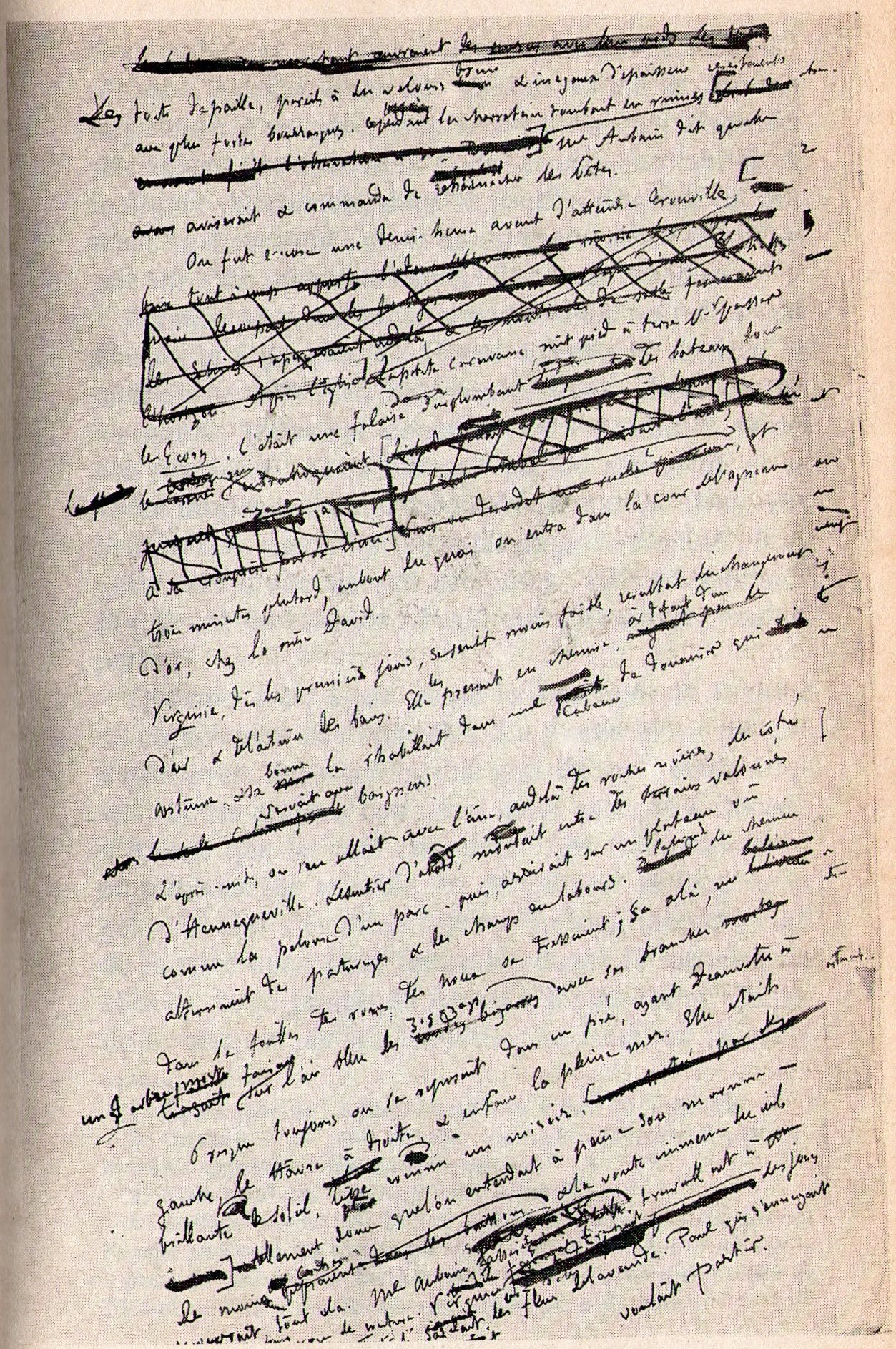
Since the early days of the first Writers’ Workshop at the University of Iowa in 1936, we have taught creative writers how to improve their skills primarily in a workshop setting, where a group of peers joins the instructor in a discussion of a draft, giving a writer feedback on their work. The writer listens, taking notes, but traditionally is silent throughout. The original Iowa model has over many years spread to become the basis of most other MFA programs—at least 250 in the U.S. today. It’s the model I was taught with in the early 2000s, first at Hopkins, and then at Columbia.
Lately there have been lots of recent discussions in the field about how to revise the workshop model to make it more useful for writers, particularly writers of color, and other writers with unrepresented cultural perspectives. In my classes lately we've looked at various new models proposed by writers like Jesse Ball and Matthew Salesses, trying to give the writer more of a say in the discussion, or an opportunity to frame that discussion in a way to direct the readers towards giving more helpful feedback.
But in all these discussions, I've noticed there's still little attention given to another big concern with the workshop model. Let’s say that the system works perfectly and the writer is given a great amount of useful feedback to work with. What’s the next step? How do we take all that great feedback and actually make our work better?
We tend to spend almost no time at all in classes talking about this next crucial step.
We say a writer must produce a “revision” but we don't really talk much about what it is or how it works or how to know if you're doing it right. Which is even more ridiculous when you consider that most writers will spend far more time in revision processes by the end, than in the process of writing that first draft.
There are stories I've been revising (off and on) for years, which took me just a week or two to get down at first.
Outside of the academic world, most writers turn to an editor, an agent, or a trusted friend to read and help find weak places in a story or a novel in progress. It can be hard for a writer at any stage to see flaws and weaknesses on their own, and we all rely on some outside eyes to help us along.
But revision, like the initial writing, is an activity undertaken alone. While I have stacks of books covering ways to approach writing, covering everything from first sentences to final words… they typically talk about revision as a kind of weird black box that lies between the rough draft and the final one, with little sense of what goes on in there at all. You “make changes” and “fix problems”. Somehow or another.
Typically I have my students offer “line level” feedback (ideally by marking up a manuscript) as well as “big picture” notes in a typed response. Micro and macro level changes can then occur… but still, that covers a pretty huge range of potential work.
What needs doing?
Cutting? Expanding? Rewriting? New writing? Addressing grammatical issues? Rearranging whole sections? Renaming characters? Adding scenes? Changing endings? Making sure the timeline all adds up. Checking facts and details. Sharpening language and images. Trimming excess dialogue tags and removing “wiggle words.” Combining smaller similar characters. Introducing new ones. Repairing plot holes. Choosing plausible impossibilities over implausible possibilities. Does it begin where it should begin? Does it end where it should end? (Start later, end sooner).
There’s so much that needs to happen.
Typically I find that when I revise, I read through from the start, and just sort of haphazardly do everything everywhere all at once—micro stuff, macro stuff, inevitably missing huge things with each pass, and so repeating and repeating and repeating and repeating until I’ve lost all sense of up or down.
In Haruki Murakami's latest book of essays, Novelist as a Vocation, he describes going through a patient series of revisions — around eight, by my count— before he shares his work with a trusted reader (his wife) and then usually doing several more revisions before turning his novel in to his publisher. At that stage, even more revisions still will come in the editorial and publication processes.
But in the three pages he spends describing this rewriting process, Murakami does not illuminate much of what he is doing in each step. What does each revision involve? Is he focusing on just one thing at a time, per revision? Or, like me, is he just fixing anything and everything he notices, over and over?
And what even is a draft anyway? A start-to-finish rewrite? Or do I count when I go in and fiddle with a few parts here or there? When writing longhand or with a typewriter, maybe it makes some sense to enumerate each individual version. But when I edit on my laptop, sometimes I save my work in a new file, sometimes I just overwrite the last one. Truthfully, I really always edit each scene a few times immediately after finishing it. I'll fix up a sentence the same way, just after I've written it, and even as I'm still writing it!
Does that count?
More and more I've thought about ways to revise more purposefully, methodically, in the hopes of saving time perhaps? Or of getting to a better endpoint no matter how long it takes.
In Refuse to Be Done, my newsletter friend Matt Bell describes a three-draft sequence, each of which invites different, distinct aims. You don’t stress a ton about the language/sentence level changes during the first exploratory draft, because you don’t yet know what’s going to have to get cut later on (and it’s actually much harder to cut writing you’ve labored over for hours or days). That’s something to focus more on in the third and final draft, once you know what the book’s overall shape will be.
Smart!
The second, middle draft Bell describes involves taking the first draft and creating an outline to organize it, before then retyping the entire thing all over again (harkening back to the old typewriter days). This also seems very smart, but each time I've tried doing this, even with just a short story, I find myself growing desperate in the process, like I'm sucking all the life out of my work by mindlessly copying it over. (Bell isn't saying to do this, in fact he wants us to rewrite quite mindfully indeed. I just can’t quite seem to manage it, yet.)
Still, the principle here that I admire is the developing of some kind of order, some sequence of stages, so that each revision has a goal in the larger process. And I’ve started to dig around in the habits of famous writers past, to see how they handled the mysterious art of revision.
Over the next few months I'll be working on a book called REVISIONARIES about the unfinished manuscripts and projects of famous writers. I'm beginning with a novel called The Love of the Last Tycoon by F. Scott Fitzgerald. Unfortunately the book was only about a third of the way finished at the time Fitzgerald died of a heart attack, but because of the incredibly detailed way in which he outlined and revised the book, it turns out that we have a pretty good idea of how it all was at least intended to be completed.
If you buy the novel in the bookstore today, what you’ll get is about 80 pages of a novel that is mostly coherent, but still has radical shifts in POV (going from first to third between chapters) and even features some characters whose names change spontaneously. In the editor’s note at the start, it is clarified that there were also numerous grammatical and spelling mistakes fixed before the part-finished book went to print.
I’m writing about it, and other books like it, for precisely these reasons. Because it is such a mess it doesn't make for great literature exactly, but it reveals a lot more than usual about the way literature is created.
Normally we only get to experience a novel in its finished, polished form, with no idea what kinds of headaches and rigmarole the poor authors had to go through in order to reach that point. But with an unfinished work, the process cannot be completed, the tracks cannot be erased, and so we’re left with not a masterpiece but a rare look at the way masterpieces are created. This, at least, is the thesis for my project—and it’s coming along well already, I’m happy to say.
To see the uncorrected “working draft” proofs of The Love of the Last Tycoon, I journeyed across state lines (OK, one state line) to Princeton, New Jersey, where the papers belonging to Fitzgerald’s estate have been preserved. Anyone is allowed to go in and, under supervision and following strict procedures, work with these manuscripts and examine them—it’s a very cool, very rare experience (Rare in that few people ever take advantage of it. As I say, it’s all totally available to the public.)

In the folders for The Love of the Last Tycoon (which was originally titled just The Last Tycoon) there are about five times as many pages of notes and outlines as there are finished manuscript pages—giving a quick visual sense of how intensive Fitzgerald’s process actually was.
On the finished manuscript pages you can see posthumous corrections made by his editor, the great Edmund Wilson, in a thin brown crayon.
But on many pages you can also see markings made in a thin red crayon by Fitzgerald himself. I was curious what they were supposed to indicate.
I found my answer in a short story Fitzgerald once wrote called “Afternoon of an Author” in which he describes a revision process that fits perfectly:
He went through the manuscript underlining good phrases in red crayon and after tucking these into a file slowly tore up the rest of the story and dropped it in the waste-basket.
The narrative around Fitzgerald’s final years revolves around his descent into alcoholism, his desperation for money (his books weren't selling well--he earned just $13.13 in royalties the year he died), his hatred of Hollywood, his separation from Zelda. The messy half-done Last Tycoon seems at first to support the notion that he had lost his abilities to write well by the end.
But in the file, I found a highly thoughtful, orderly process.
Fitzgerald would first handwrite a draft of a scene on long paper, and then later go through with his red crayon and flag certain sentences or phrases, or even just words, that he liked. Usually relatively few things on a page would get a red crayon underlining, but these would be enough to get him started.
He then would type these out onto a sheet of new paper, one a time, in a list, interspersed with other notes and thoughts he was having about the scene. As he went into a typed rough draft then, he would drop these lines in one at a time, wherever he felt they belonged, and cross them off as he went. The process could then begin anew, as he moved over the typed rough draft, cutting out bits he didn’t like and flagging other parts that should stay in.
A few short stories were tucked into the file as well, similarly culled with red crayon. He labeled them: “Stories Scavenged for Tycoon” and pulled a few phrases out that he wanted to reuse now in his novel":
attitude like Portrait of the Artist
The blue-green unalterable dream
When Stahr is drunk he is silly
Don’t make her Tarkington
She first discovered love in her throat
Look up about mains and power lines
The third, fourth, and sixth items here are just notes to himself. The others are lines or parts of lines he wanted to repurpose. Once he found a new spot for them, he checked them off (in red again) to indicate they’d found a new home.
All in all, it is a remarkably efficient system for moving good language around in a work, or even in-between works. I especially love the idea of a “Scavenge” folder, where old stories and bits of drafts of other abandoned projects can go to wait to be picked over at some future moment—it reminds me a little of gardening. The best parts of bad stories are still good for something, and can seed the new work now. Fitzgerald wrote tons of short fiction that wasn’t, in his mind, always intended to be high art. They were how he kept the lights on, like his later gigs writing screenplays. I love that they became a crucial piece of his revision process.
I also discovered a second useful revision tool, which Fitzgerald described once in a letter to John O’Hara:
Invent a system […] buy a file. On the first page of the file put down an outline of a novel of your times enormous in scale (don’t worry, it will contract by itself) and work on the plan for two months. Take the central point of the file as your big climax and follow your plan backward and forward from that for another three months. Then draw up something as complicated as a continuity from what you have and set yourself a schedule.
Fitzgerald’s method of outlining a novel is a helpful way of organizing the order of the specific plot events, and of seeing the shape of the entire work all at once.
First, by hand, Fitzgerald assembled a simple table containing three columns: Episodes, Chapters, Acts.
In the column marked Episodes, Fitzgerald listed a numbered series of incidents in the novel, some of which he had begun fleshing out in drafts already, and others which was preparing for.
Here are the first three:
1. The plane
2. Nashville
3. Up forward. Different
They are not detailed, or even really sensible to anyone but himself.
Next, Fitzgerald put an “A.” to indicate that these three will go together as part of the first Chapter, which is then detailed in the neighboring column. (He also includes the date of the episodes: June 28, and an approximate wordcount: 6000.)
In the middle Chapter column, he could address episodes 1, 2, and 3 as a whole piece. He made notes of the important things viewed at this level. In this case, for Chapter A, he simply listed the main characters introduced: “Chapter (A) Introduce Cornelia, Stahr, White, Schwartze). In other rows, he went into other details, though never much: “Chapter (G) The blows fall on Stahr. Some of heat all through, culminating in 25.”
In the final Acts column, he further collated his Chapters into acts, five total, utilizing the classic theatrical structure. Chapter A, containing episodes 1-3, was the whole of Act I. He wrote simply “JUNE (THE PLANE) 6000 STAHR. Again, these were meant only to focus his own attention on the particulars of the story at this point.
Act II was then longer, gathering up Chapters B-E, and Episodes 4-16. He wrote here, “ACT II (THE CIRCUS) July--early August 21,000 STAHR AND KATHLEEN”
And on it went, eventually demarcating thirty episodes into nine chapters, making a full five acts at 51,000 words.
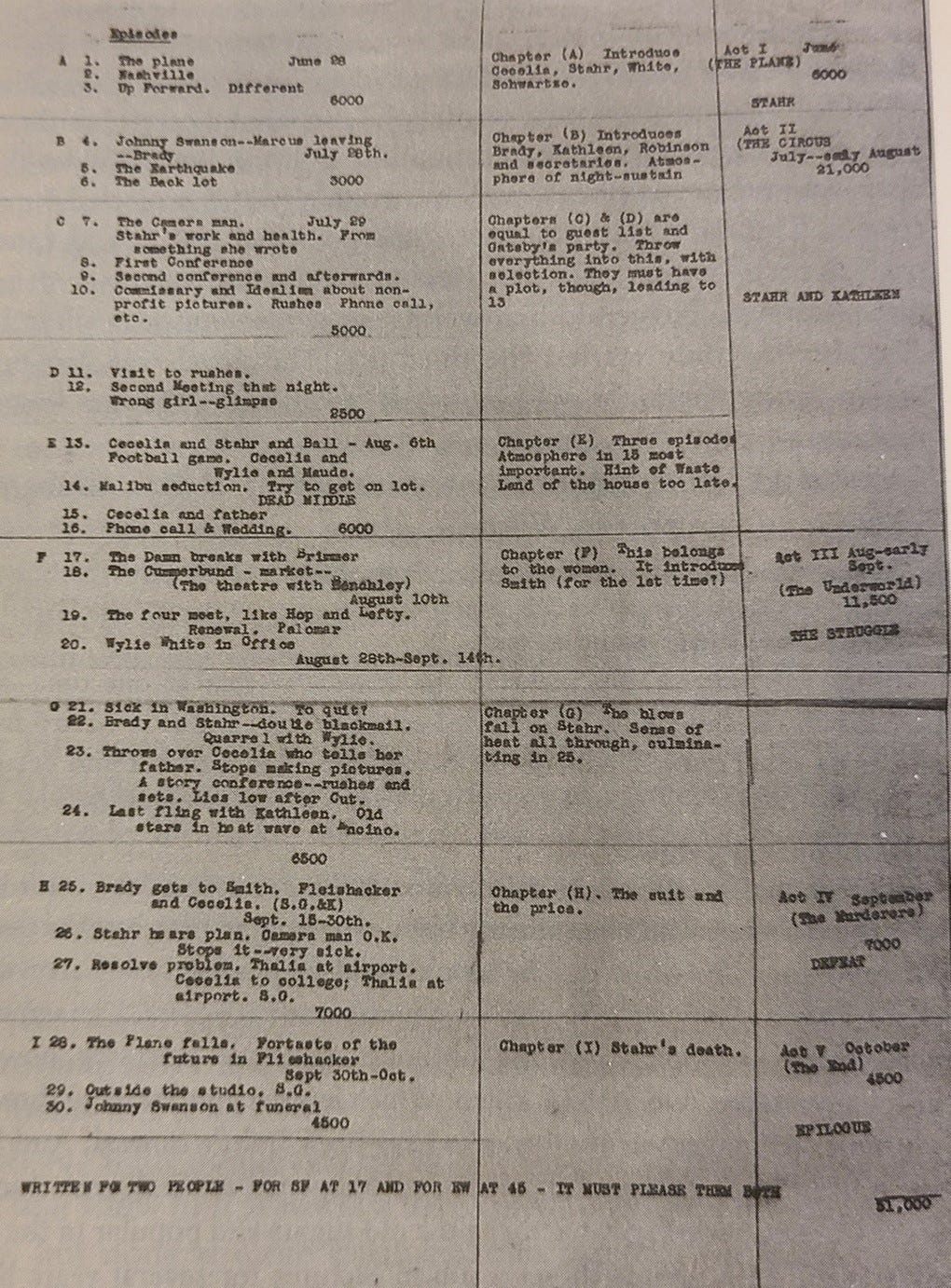
This chart was refined and then typed up, with notes added in pencil, and then it was retyped. In the “Latest outline-plan” (shown above) he added one note at the bottom, in all caps.
WRITTEN FOR TWO PEOPLE – FOR SF AT 17 AND FOR EW AT 45 – IT MUST PLEASE THEM BOTH
SF for Scottie Fitzgerald, his daughter. EW for Edmund Wilson… a constant reminder to himself of who this book was for, each time he consulted the chart.
The outline would end up being invaluable for his editors and later scholars trying to work out where the novel would have gone, had Fitzgerald not died before finishing it.
But for Fitzgerald then, it was simply a remarkably clear and efficient way of outlining a novel, and one that is easily replicable by any writer embarking on the journey themselves. Clearly, concisely, it organizes the story and holds it to a shape, not quite like pouring concrete into a mold, but rather sketching a blueprint that can be followed, altered, adjusted, as the process continues and the novel’s form reveals itself more fully.
According to Fitzgerald’s secretary, Frances Kroll, he followed this method closely. He began with his handwritten rough draft pages and organized those into chapters. (He intended there to be nine chapters, just like in The Great Gatsby.)
Only when the episodes were each handwritten, did he begin a rough draft of the chapter itself, longhand. Kroll would turn these into a typescript, which he would then revise, ultimately moving things from chapter to chapter as needed. He also polished dialogue, sometimes by reading scenes out loud to himself. If he ever felt that his rhythm was off, he would ask Kroll to read aloud from the King James Bible until he found the proper tempo again.
Following this method, in fourteen months, Fitzgerald accumulated 1,100 draft pages of seventeen episodes, plus 200 pages of background notes. None of these were yet considered to be final, not even the only completely assembled chapter, the first, which Fitzgerald had left marked “Rewrite from mood. Has become stilted with rewriting. Don’t look rewrite from mood.”
It’s stunning that, after all that, he felt like he was not even ready to set those first chapters into stone yet—that he knew that with all his rewriting zeal, he had somehow ended up with something that felt off—and needed to now be rewritten again.
It’s a nice reminder to me, and to all of us, that this is why it is so hard to talk about revision… because if it were as simple as coming up with a one-size-fits-all formula, well, we’d end up with a bunch of stilted writing by the end. Ultimately, revision needs to come from “mood” which is to say, it has to have heart, and it has to be imaginative and exciting and alive. It is an art form unto itself, really, but that doesn’t mean it has to be all groping in the dark every time. We can practice revision, improve at it, find methods that help us get a handle on it, and deal with the big changes and small ones in some kind of orderly way.
Next month I’ll take a look at some more things that we can try, coming from the methods of another great writer, and we’ll try to put as many tools in our toolboxes as possible. Until then, good luck, and have fun!
Love this! Thanks for sharing, I'm in the middle of my first draft and can already see how much what I've written will need to be revised or rewritten entirely...
Thank you for this thought- and revision-provoking piece!
I see that both Fitzgerald and Murakami went/go through the initial revision stages (largely) alone, without feedback from others, only later turning to a trusted few for advice. I am skeptical of the workshop feedback model, not because the advice is necessarily wrong, but because the many pieces of advice added up do not make a whole. Also, some of the feedback may be poorly thought out--spoken mainly for the sake of saying something. The best aspects of a writing workshop (for me) are the built-in readership and listenership, the challenge of deadlines, the camaraderie among the students, the instructor's knowledge and wisdom, and the shared premise that the endeavor is important.
Speaking of listenership, it's fascinating that when Fitzgerald felt that his rhythm was off, he would ask Kroll to read from the King James Bible. I imagine most writers have touchstones of one kind or another: maybe sacred texts, particular works of literature, maybe music, maybe long walks, maybe the sounds of people bustling and haggling at a farmer's market.